Learning to Drive in Woodbridge? Here’s What Nobody Tells You Before You Start

There’s a very specific kind of nervous energy that comes with learning to drive in Woodbridge, Virginia. With all the intersections, traffic jams on I-95, and roundabouts that drive you crazy, it’s not exactly the gentlest place to get behind the wheel for the first time. And yet, thousands of new drivers do it every year, and most of them come out the other side perfectly confident, capable drivers. The secret usually isn’t talent. It’s choosing the right driving school in Woodbridge and actually understanding what the process looks like before you dive in.

So, if you’re a teen with a little fear in your heart for the big day when you’re driving, a parent trying to figure out a ton of paperwork to process, or an adult learner who just didn’t get to driving lessons back then, then this one is for you.

Why Woodbridge Is a Tricky (But Great) Place to Learn

Let’s be real, Woodbridge isn’t the easiest training ground. Heavy commuter traffic, busy shopping corridors, and a mix of highway merges and residential side streets mean new drivers get exposed to a little bit of everything. But the good news is, if you can master the art of driving with confidence in Woodbridge, you will be able to drive pretty much anywhere in Virginia. That’s actually one of the biggest advantages locals don’t always realize: learning in a hectic area builds sharper instincts than learning somewhere quiet and predictable.

This is exactly why picking the right driving school in Woodbridge matters so much. A good instructor doesn’t just explain to you the rules of the road; they teach you how to read traffic patterns, make the correct decision on how to merge traffic lanes, and stay calm when three lanes are trying to become one near the highway exit.

What Actually Happens During Driver’s Ed (Step by Step)

A lot of new students picture driver’s ed as one long, intimidating experience, so let’s break it into pieces:

First, there’s the classroom or online portion, where you’ll learn Virginia traffic laws, road signs, and safe driving fundamentals. This section helps you develop the “book knowledge” before you get behind the wheel of a car.

Next comes the behind-the-wheel instruction, where a certified instructor will join you on the road as you learn the necessary driving skills and strategies, such as parking, merging, navigating intersections, and yes, eventually, parallel parking (everyone’s least favorite milestone).

Finally, once you’ve completed both portions successfully, you receive your Virginia driver training certificate, which is the official document proving you’ve met the state’s requirements. This certificate is required before scheduling your DMV road test, so it’s not just a formality; it’s your ticket to the next stage of independence.

Why the Certificate Actually Matters More Than People Think

New drivers (and honestly, a lot of parents) sometimes assume the certificate is just paperwork to file away. In reality, your Virginia driver training certificate is proof that you’ve completed state-mandated training hours and met the curriculum requirements set by the DMV. You will not be able to go ahead with scheduling your road test, regardless of how confident you feel behind the wheel. It’s best to keep a copy in a safe place (digital and physical) as you can use it again in the future, particularly if you are using it for cheap insurance quotes as a newly licensed driver.

Why Choosing the Right School Changes Everything

Here’s something that doesn’t get talked about enough: not every driving school feels the same once you’re actually sitting in the car. Some instructors are too quick through lessons, some barely explain anything beyond “turn here, stop there.” A genuinely good driving school in Woodbridge takes the time to explain why a maneuver works, not just how to do it, which builds real confidence instead of memorized habits.

This is part of why so many local families specifically search out 2020 Driving School when it’s time to start lessons. With instructors who’ve spent years training students across Woodbridge, Stafford, and the greater Northern Virginia area, the focus stays on building genuinely safe, capable drivers, not just passing them through to get them on the road. It’s also what makes the teaching of many students so much more than a license, but an actual confidence in dealing with heavy traffic long after the official lessons end.

The Bottom Line

Learning to drive in Woodbridge might feel intimidating at first, but it’s also one of the best places to build genuinely strong driving instincts. Between proper classroom instruction, hands-on practice, and earning your Virginia driver training certificate, the process is more structured (and more manageable) than most beginners expect. Select the appropriate school, learn one lesson at a time, and soon you will find yourself saying, “Wait, I actually got this.”

FAQs

How long does it take to complete driver’s education in Virginia?

Most programs combine classroom (or online) instruction with behind-the-wheel hours, typically taking a few weeks to a couple of months, depending on scheduling. Many students complete it faster during summer breaks when more lesson slots are available.

Do I need a learner’s permit before starting driving lessons?

Yes, in most cases, you’ll need a valid learner’s permit before behind-the-wheel instruction can begin. Classroom or online instruction, however, can often be completed even before you’ve obtained your permit.

What is a Virginia driver training certificate used for exactly?

It’s official proof that you’ve completed state-required driver’s education, both classroom and in-car instruction. You’ll need it to schedule your DMV road test, and it may also be requested by insurance providers for young or new driver discounts.

Can adults take driver’s ed too, or is it just for teens?

Absolutely, adult learners take driving lessons all the time, whether they never learned earlier in life or are building confidence after a long break from driving. Many schools offer adult-friendly scheduling and pacing.

What should I look for when choosing a driving school in Woodbridge?

Look for DMV certification, experienced instructors familiar with local roads, flexible scheduling, and clear communication about what each lesson will cover. A school that explains the “why” behind techniques, not just the “how,” tends to build more confident, capable drivers.

That Ticket Doesn’t Have to Wreck Your Year: A Real Talk Guide to Driver Improvement Clinics

Let’s be honest about something nobody likes admitting: almost every driver, no matter how careful, ends up with a ticket or a court date at some point. You may have run through a stop sign when you were distracted, you might have been driving 12 over on a road that felt empty, or maybe the DMV just flagged your record for one too many points. No matter where you came from, take a breath. A driver improvement class is not a punishment designed to humiliate you; it’s actually one of the simplest, most painless ways to fix a messy driving record and get back to normal life behind the wheel. 

If the phrase “driving improvement class dmv” just landed you on this page after a frantic late-night Google search, you’re in the right place. Let’s figure out what these classes are, how they are more valuable than you would think, and how to choose a class that won’t suck up your Saturday.

Wait, What Even Is a Driver Improvement Class?

A driver improvement class is a structured course, usually a couple of hours, which is designed to help drivers brush up on safe driving skills for a driver who has received a ticket, an accident, or a court order. There are times when it is mandatory (a judge or the DMV tells you to take it), and sometimes it’s voluntary (you take it proactively to knock points off your license or lower your insurance premium). 

Either way, the goal is the same: to refresh your knowledge of Virginia traffic laws, sharpen your decision-making on the road, and prove to the DMV that you’re taking your driving record seriously. 

Here’s the part that surprises people: it’s not a lecture where someone calls you out on your mistakes. Good instructors treat it like a reset button, a chance to walk out knowing more than you walked in with, not less confident than when you arrived.

Defensive Driving vs. Driver Improvement: What’s the Difference?

This trips a lot of people up, so let’s clear it up quickly. A defensive driving class for VA residents often focuses specifically on anticipating hazards, reacting to other drivers’ mistakes, and avoiding accidents before they happen. It’s proactive, skill-based training. A driver improvement course, on the other hand, is usually associated with your current violation history and is often required by the court or DMV as a condition tied to your license or points. In many cases, the two overlap heavily, and a single course can satisfy both purposes, which is honestly the most efficient way to handle it. 

When looking for a defensive driving class VA requirement, be sure to verify that the court paperwork specifically says “defensive driving” or “driver improvement,” since the wording matters when it comes to satisfying legal requirements. 

Why It’s Worth Doing Even If You’re Not Required To

Here’s a fun fact most people don’t know: voluntarily taking a driver improvement class can actually add safe driving points back to your Virginia record, which can help to offset points lost from a previous violation. That means even if nobody is forcing you to sit through one, it can quietly work in your favor, lower insurance premiums, cleaner records, and, frankly, better instincts on the road. Nobody regrets becoming a sharper driver. Plenty of people regret ignoring the warning signs until it’s too late.

Why the Instructor (and the School) Actually Matters

Not all driver improvement classes are created equal, and this is where experience really shows. A class that is led by instructors who’ve spent years working in direct contact with Virginia drivers, who know the local roads, common violation patterns, and what DMV reviewers actually look for, is going to feel more relevant than a class that has a generic copy-paste course. This is exactly why so many Virginia drivers specifically search for 2020 Driving School when they need a DMV-recognized and locally trusted driving improvement class. 

With instructors who’ve logged real hours training thousands of students across Fredericksburg, Stafford, and Spotsylvania, the difference between “checking a box” and “actually learning something” becomes pretty obvious in the first twenty minutes of class. 

The Bottom Line

A ticket, a court order, or a few too many points on your license can feel like a personal failure, but it really isn’t. It’s just feedback. Taking a defensive driving class in VA that trusts and recognizes the value of a proper driving improvement class, DMV standards require, isn’t about punishment; it’s about getting back on track quickly, confidently, and without unnecessary stress. The drivers who manage to do this well are generally the ones who don’t see it as a speed bump, but as a roadblock.


FAQs

How long does a driver improvement class take to complete?

Most driver improvement classes run about 8 hours, though some shorter supplemental courses can be as brief as 4 hours. Online versions often let you pause and resume, so you’re not locked into one long sitting.

Will taking a driver improvement class lower my insurance rates?

In many cases, yes. Completing an approved course can help reduce points on your record and may qualify you for a “safe driver” discount with your insurance provider, though it’s always smart to confirm details directly with your insurer.

Is a defensive driving class the same thing as traffic school?

They’re closely related but not always identical. “Traffic school” is a general term, while a defensive driving class is usually more structured around hazard awareness and accident prevention.

Can I take an online driver improvement class instead of going in person?

Yes, in most cases. Virginia offers DMV-approved online driver improvement courses that satisfy the same requirements as in-person classes, making it easier to fit the course around a busy schedule.

What happens if I don’t complete a court-ordered driver improvement class?

Skipping a court-mandated class can lead to additional fines, license suspension, or further legal complications. It’s always best to complete the course well before any deadline to avoid added stress or penalties.

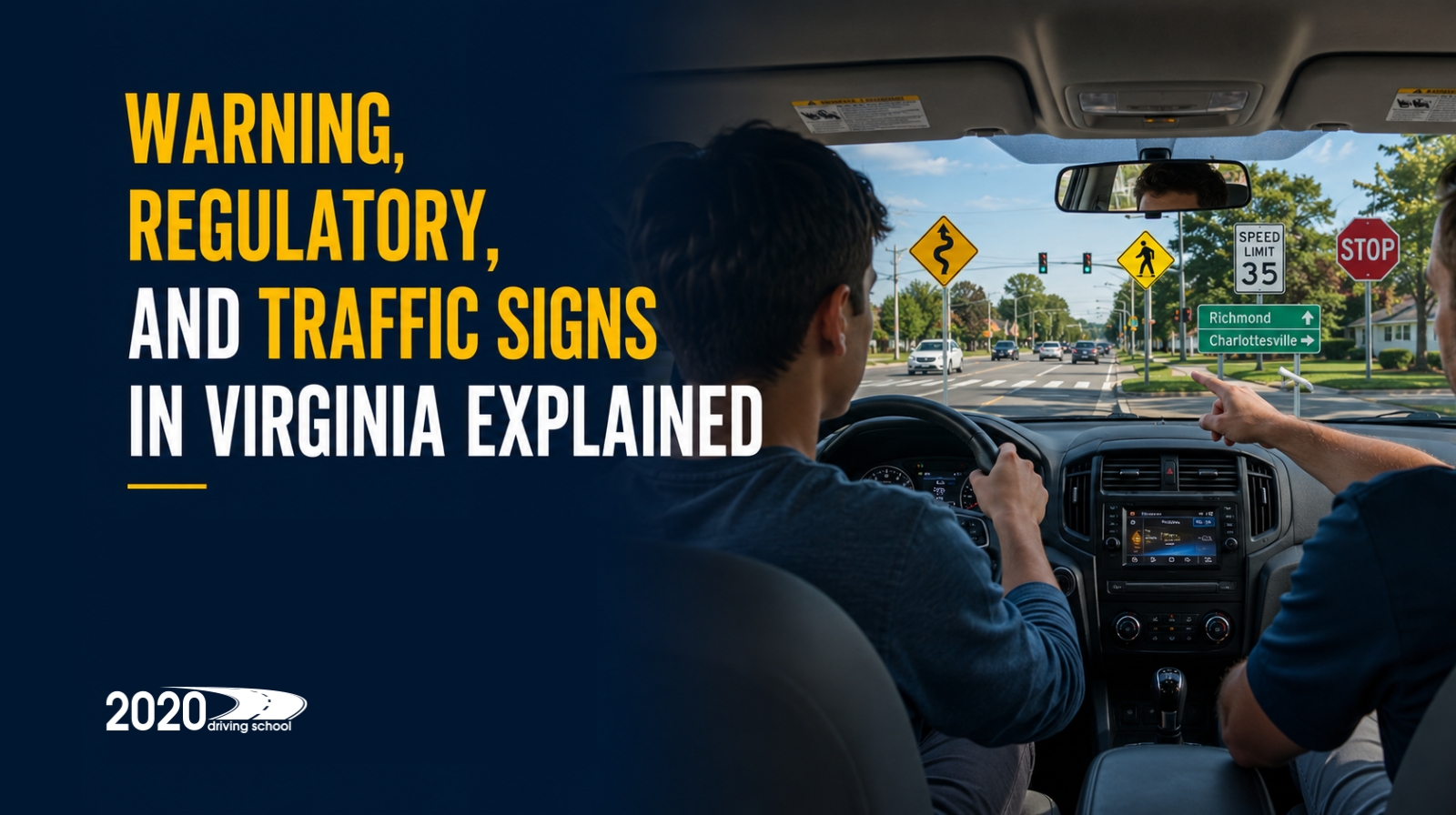
Warning, Regulatory, and Traffic Signs in Virginia Explained

One of the key parts of becoming a safe and responsible driver is having a clear understanding of Virginia road signs. Whether it is someone who is preparing for a learner’s permit test, attending a driving school, or simply refreshing their driving knowledge, when you recognize the traffic signs, it becomes safer and less confusing on the road. Each sign has been designed to communicate important information quickly, which allows the driver to react appropriately to the changing conditions of traffic, hazards, and legal requirements. The road signs in Virginia have been divided into 3 major categories: warning signs, regulatory signs, and guide or traffic signs. By understanding the purpose of each category, you are able to make it safer to drive. 

Warning Signs Alert Drivers to Potential Hazards

Warning signs are used to warn drivers of upcoming road conditions or danger. These signs are typically yellow or orange in color with black symbols or lettering and are easy to see from a distance.

Many Virginia road signs in the warning category assist the driver in modifying their speed or driving behavior in advance of dangerous areas. Warning signs, such as curves, signal drivers to turn aggressively, and traffic flow signs warn when traffic patterns are changing, such as when merging into or out of a lane. 

Some common warning signs drivers encounter in Virginia include:

  • Pedestrian crossing signs
  • Deer crossing signs
  • Slippery when wet signs
  • School zone warnings
  • Railroad crossing alerts

Construction zone warning signs are also very crucial. Orange signs are used to mark temporary hazards or changes in traffic due to road work. Always reduce speed and be alert in construction zones, as lane changes and lower speed limits may occur.

Knowing the signs of danger can help drivers make better decisions in advance of a dangerous situation. 

Regulatory Signs Communicate Traffic Laws

Regulatory Signs instruct drivers on what they are permitted or not permitted to do when driving. These signs are legally binding, and a failure to follow them could lead to traffic citations, fines, or accidents. The majority of regulatory signs in Virginia are white with black or red text and symbols. These signs contain instructions about speed, lane use, stopping, and parking.

Stop signs, yield signs, and speed limit signs are a few of the most well-known signs. Signs include stop signs, which should be obeyed by stopping before safely proceeding, and yield signs, which mean that drivers must yield the right-of-way if they are required to do so. 

Additional regulatory signs commonly found on Virginia roads include:

  • No U-turn signs
  • One-way traffic signs
  • No parking zones
  • HOV lane restrictions
  • Do not enter signs

Regulatory signs play a critical role in traffic flow and roadway safety, and are the most important signs for drivers to look at. Failure to take these behavior indicators into account can lead to more accidents and hazardous driving conditions for other people. 

Guide and Traffic Signs Help Drivers Navigate

Guide signs give direction and help the driver navigate unfamiliar roads, highways, and cities. Often green, blue, or brown, depending on the purpose. Highway exits, route numbers, street names, and distances are commonly found on green guide signs. Blue road signs usually denote services for travelers, like gas stations, hospitals, lodging, or rest areas. Brown signs are generally used for parks, recreation facilities, or historic sites.

A lot of Virginia road signs are created to assist motorists in better navigating the busy highway system. In urban areas with complex traffic flow, interstate signs, directional arrows, and lane guidance signs are particularly critical. Other signs for traffic control are traffic lights, pedestrian crossing signs, and lane control systems. All drivers should be alert for them and follow the respective signs and signals to ensure no collisions or traffic violations occur on a regular basis. 

Why Learning Virginia Road Signs Matters

The knowledge of road signs is crucial for all drivers, whether novice or expert. Road sign recognition is one of the most important portions of the written DMV exam for teens who are taking the test for their driver’s license. A lot of permit applicants have a problem because they have to recite the answers without actually knowing what the signs are.

It would be beneficial for experienced drivers to check out the Virginia road signs, especially because the regulations and traffic patterns might change from time to time. Being aware of the latest information is crucial for drivers to maintain safety and confidence on the road. Knowing the road signs also helps develop defensive driving. Quickly identifying signs allows drivers to be better prepared to respond to hazards, adjust driving speed, and make safe decisions in traffic.

Learners develop confidence by learning traffic laws, identifying road signs, and safe driving techniques from professional driving schools like 2020 Driving School. 

Tips for Memorizing Virginia Road Signs

Road signs are easier for new drivers to remember by looking at the color, shape, and pattern of the symbols. For instance, octagon-shaped signs are always stop signs, and triangle-shaped signs are typically yield. 

A few effective study tips include:

  • Reviewing DMV road sign charts regularly
  • Taking online practice permit tests
  • Studying sign categories separately
  • Practicing identification while riding in a vehicle

Regular practice will enhance recall and help drivers act appropriately in real-life scenarios.

Knowing the meaning of Virginia road signs is not just vital to passing the driving test but also for being a better, safer, and more responsible driver. The knowledge of the warning, regulatory, and traffic signs allows drivers to approach Virginia roads with confidence and awareness. Want assistance with your written test? Call you today and book your seat with 2020 Driving School.

FAQs

1. What are the main categories of Virginia road signs?

The main categories are warning signs, regulatory signs, and guide or traffic signs.

2. What color are warning signs in Virginia?

Most warning signs are yellow or orange with black symbols or lettering.

3.Why are regulatory signs important?

Regulatory signs communicate traffic laws and rules that drivers must follow for safety and legal compliance.

4.How can I study Virginia road signs for my permit test?

You can study DMV manuals, practice tests, road sign charts, and driving school materials to improve recognition and understanding.

5.What happens if drivers ignore traffic signs?

Ignoring traffic signs can lead to accidents, traffic violations, fines, and unsafe driving conditions.

Disclaimer: Home and school pickup/drop-off may be available for students located in Fredericksburg, Spotsylvania, and Stafford. Eligibility depends on your exact address, distance, and instructor availability, as most instructors are based within these areas. If your location falls outside our service range or beyond our pickup radius, you will be assigned a designated pickup location. Please refer to our pickup locations here. For confirmation of eligibility, we recommend calling our office before scheduling.

The Virginia DMV is committed to promoting transportation safety through the certification of quality driver training programs. If you have comments or concerns about this driving school, call the DMV toll-free number: (877) 885-5790

Call Us
+1 540 841 6327
Inquiry Now