
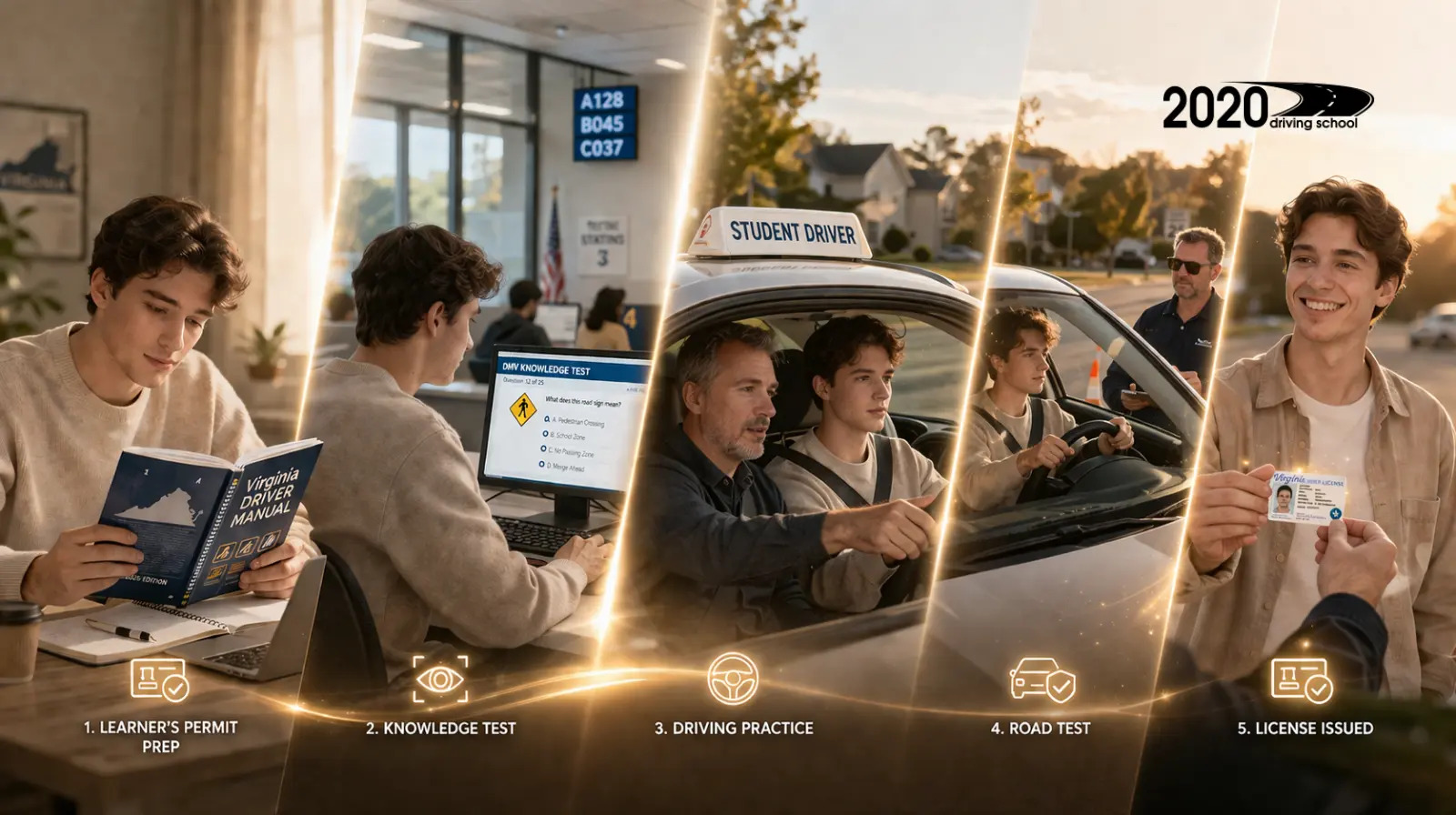
Getting a driver’s license in Virginia in 2026 has become more convenient and accessible. All thanks to the updated regulations, digital learning options, and better testing systems. Understanding the Virginia DMV licensing is essential, whether you are a first-time driver or an adult learner. This will ensure that you enjoy a smooth process throughout. In this guide, we will break down the whole thing for you, including what steps you need to perform, the requirements, and practical tips you can use for success.
Understanding the Virginia DMV Licensing Process
The DMV licensing system of Virginia follows a gradual approach, particularly in the case of teens, but in the case of adults, one can take a more direct path. The process contains a total of five major steps that we have discussed in detail below. The different levels are structured in such a way that the drivers not only know it but also can handle the driving conditions in the real world.
Step 1: Application for Learner Permit
In order to start the process of licensing at the Virginia DMV, one should receive a learner’s permit. The requirements for attaining a learner’s permit are: minimum age of 15 years and 6 months, vision screening, and necessary identification and residence documents. Applicants are supposed to pass the examination, which consists of both road signs and general driving rules. The permit will enable the learner to drive under the guidance of a licensed adult. In case of teens who are learning to drive, this is a compulsory stage, whereas adults can move faster based on their level of experience.
Step 2: Finishing the Driver Education
The Virginia DMV licensing process mandates finishing driver’s education, particularly when considering the applicants who are below 18. The driver’s education program must include 36 classroom sessions (or online equivalent), cover safety regulations, road codes, road consciousness, and defensive driving techniques. Hybrid or completely online options are provided by many driving schools today, and thus, it is more feasible to fulfill this requirement when attending school or working.
Step 3: Behind the Wheel Training
The road test is taken after having taken a practical driving experience.
Key components of behind the wheel training:
- Minimum 7 driving sessions
- 7 observation sessions
- Driving experience (highways, traffic, parking)
The professional training is a major boost in confidence and minimizes the risks of failing the exam.
Step 4: Road Skills Test
The last and most important process in licensing by the DMV of Virginia is the road test.
What to expect:
- Vehicle control assessment
- Traffic rule compliance
- Parking maneuvers
- Turns and lane changes.
Some of the frequent errors faced by applicants are the failure to look at blind spots, inappropriate signals, and nervous driving. Guided practice can help a lot in preparation.
Step 5: License Issuance
Upon passing the road test, you will be issued with your driver’s license. Adolescents are issued with a temporary license with limitations, whereas adults are granted one without restriction. The license is issued in both digital and physical copies. To further enhance the convenience of drivers, Virginia is continuing to expand access to digital licenses as well.
How to Pass Your Driving Test?
Achievement in the Virginia DMV licensing exam requires preparation and regularity. Ensure that you practice driving in various situations frequently. Where necessary, get professional lessons. Read the Virginia DMV driver’s manual carefully beforehand. During the exam, try to stay as calm and composed as possible and try to learn the test routes.
A better preparation ensures a higher level of confidence and guaranteed success. However, many times applicants might face certain issues that can affect their test, such as test anxiety, absence of experience, lack of understanding of traffic laws, and issues with parallel parking and maneuvering. These are not major problems and can be easily overcome by getting professional training and mock tests.
Learn More: How to Pass Your DMV Road Test?
What’s New in 2026?
There are some new changes that have been implemented by the Virginia DMV licensing system. Such changes are intended to produce more responsible and skilled drivers. These recent updates include:
- More online driver education.
- Faster appointment booking via digital media.
- Increased testing criteria on real-world conditions.
- Increased defensive driving and safety awareness.
Final Thoughts
The Virginia DMV’s licensing procedure has been updated in 2026, with the intention to make it more extensive and adaptable. Having both theoretical and practical skills, the applicants are more equipped to handle real-world driving. Using every step carefully and taking time to be properly trained, you are guaranteed to get your license safely and easily.
FAQs
-
How long does the Virginia DMV licensing process take?
Ideally, the time for teens is around 6-9 months, which is because of the mandatory training requirements. However, adults can complete this process in a shorter time period, depending on their level of skill and confidence.
-
Can I complete Virginia DMV licensing online?
Absolutely. Classroom driver learning can be completed online; however, the behind the wheel training is to be completed in-person.
-
What happens if I fail the road test?
There is a short waiting period after which you can reappear for the test. It is recommended that you take additional lessons before you retry.
-
Is driver education mandatory for adults in Virginia?
It isn’t mandatory, yet highly recommended for applicants to improve their driving skills. This will also allow you to pass the test in a single attempt.
-
What documents are required for Virginia DMV licensing?
You will need to provide the following documents: proof of identity, residency, legal presence, and a Social Security number, along with completed application forms.
 1. Personalized Skill Development
 2. Test-Ready Results
 3. Flexible & Convenient Learning
 4. Safe & Professional Training